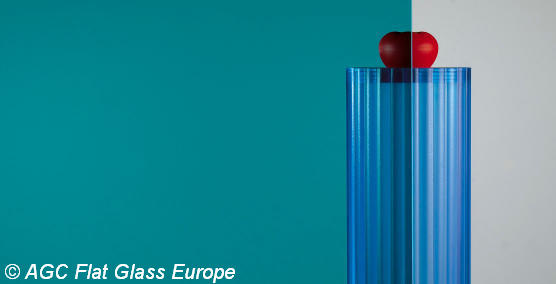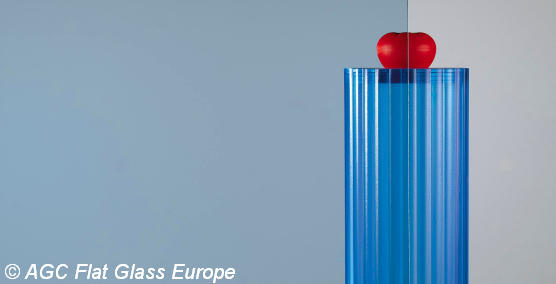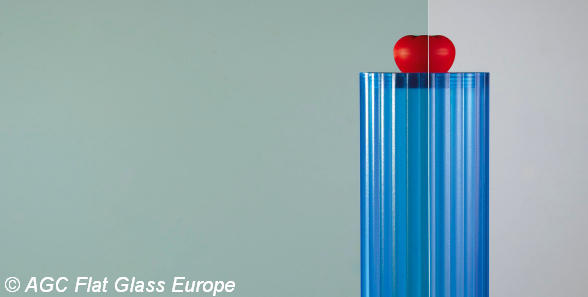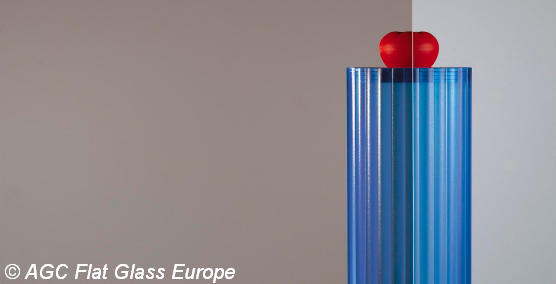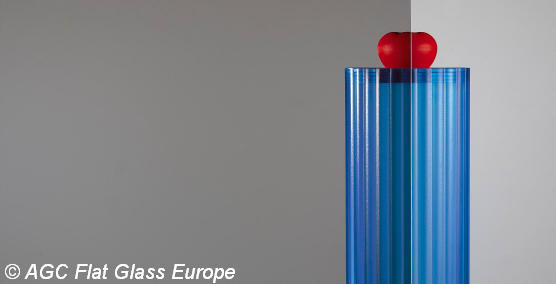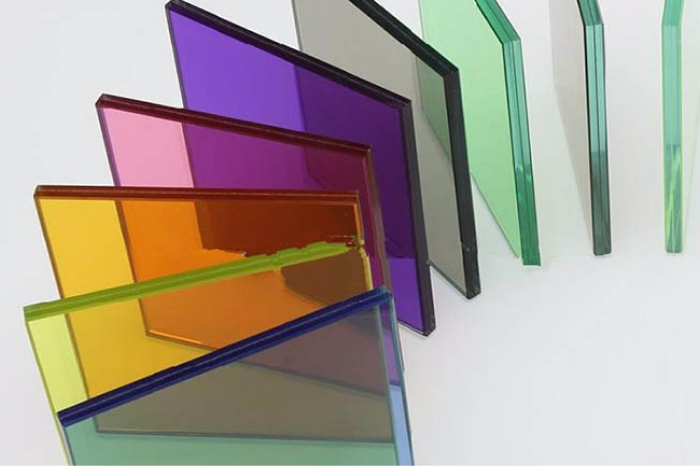
The production technology of tinted glasses is similar to that of the clear float glass, the difference is that at the beginning of the production process metal oxides are added to the main raw materials – that changes the glass color to green, blue, grеy or bronze.
Apart from its function in an aesthetic sense, tinted float is primarily designed to reduce solar heat gain, UV and glare inside a building.
Tinted float glass achieves its performance by absorbing solar energy and so is sometimes referred to as heat absorbing glass. This heat absorbing quality means the glass is thermally stressed so some thicker or darker products may need to be toughened to avoid thermal stress breakage.
Tinted float can be processed into heat strengthened, toughened, laminated, curved glass and Insulating Glass Units.
- Grey float is the traditional medium grey tinted glass characterized by its low light transmission and good control of solar heat and glare.
- Bronze float is the traditional medium bronze tinted glass designed to reduce solar heat and glare but providing a higher visible light transmittance than grey.
- Green float was initially used for automotive applications as it has very high light transmission. Modern green tints offer better solar performance with superior light transmittance to traditional grey and bronze tints.
- Dark Blue provides an alternative to grey and bronze tint with comparable solar control performance.
- Light Blue is ideal if a thicker glass is required with high light transmission.
The solar control properties of tinted glass are the result of two basic laws of physics. Firstly, darker colors absorb more heat than lighter colors. Therefore a dark tinted glass absorbs more heat than a light color tint, and hence it re-radiates more heat, which we are able to feel.
Secondly, the law of energy equilibrium is that all energy including heat constantly tries to reach a state of equilibrium. It does this by constantly moving from hot areas to colder areas. Since the glass absorbs heat the glass temperature rises as a consequence and the glass temperature rises above the ambient temperature outside and inside. The heat generated tries to find its equilibrium and it does this by means of convective transfer with the cooler air mass which is normally on the outside of the glass. Thus heat is radiated out of the glass to the outside of the building and less heat is radiated to the inside due to the very still air conditions inside.
To summarize, tinted glass is used as solar control glass because it absorbs more heat than clear glass and radiates a majority of the absorbed heat to the outside by means of natural convection.
Tinted glasses are widely used in the construction industry, interior design, production of insulated glass units, furniture manufacture, for partitions, railings and other.
Possible thicknesses: 4mm, 5mm, 6mm, 8mm, 10mm, 12mm.
Standard dimensions: 3210mmх2250mm, 3210mmх6000mm.
Colors: Light green, dark green, light blue, dark blue, aqua blue, ink blue, grey and bronze
Benefits:
Low level of light reflection
High solar factor
Stained Glass
Interior Partitions and Doors
Kitchen Backsplashes and Furniture